Atmospheric corrosion: what it means for the inspector
Atmospheric corrosion is the rusting of outdoor, uninsulated steel from air and moisture. It needs no process fluid. The damage starts where the paint or coating has broken down or where water and debris sit, and it is worse in coastal, humid or polluted air. It is visible, so it is mainly a matter of looking.
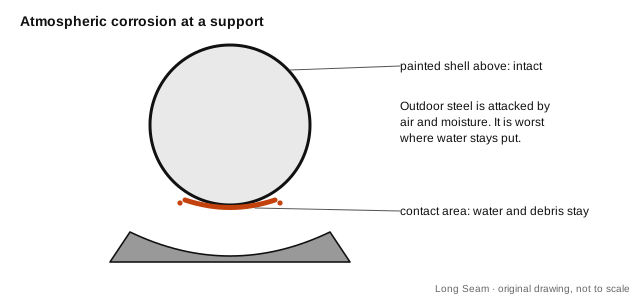
How it works
Steel exposed to air and moisture rusts. Paint and other coatings slow that by keeping water and oxygen off the metal, so atmospheric corrosion is largely a story about coating breakdown. A scratch, a chipped edge, an aged coating or a poorly prepared surface lets moisture reach bare steel, and rust forms and spreads under the coating.
Environment matters. Marine air with salt, humid climates, and air with industrial pollutants speed it up. Surfaces that stay wet for long periods corrode faster than ones that dry quickly.
Try one question
Question 1 of the free 10-question check on API 510. No signup.
IV. Practical knowledge - general
Which hydrotest situation carries the highest brittle fracture risk?
Choose an answer to begin
Where it shows and how it is found
Corrosion starts where moisture lingers.
- Supports, saddles and base rings, where water and debris collect at contact points.
- Nozzle flanges, bolting and threaded connections.
- Horizontal ledges, welded clips, ladder and platform attachments.
- Edges, corners and anywhere coating is thin.
- Drip points under leaking valves or relief devices.
Visual examination is the first tool, because the damage is on an exposed surface. Inspectors look for coating failure, rust scale, blistering paint and pitting. Where rust is heavy, they clean the area and take UT thickness readings to see how much metal is gone. Photos and mapping of the damaged areas help track progress over inspections.
Ask Patch before you buy AI your Long Seam study buddy
See what's on the API 510 exam, take the free 10-question check, or find the plan that fits you.
The API 510 course
Available now · instant accessLearn every Body of Knowledge section, work the calculations step by step, then prove it on timed exams.
- 8modules of lessonsEvery task on the outline
- 2full-length timed exams170 questions in 390 minutes each
- 481practice questionsEach one explained
- 6worked calculationsStep by step
- 1week-by-week study planSet to your exam date
Turn a practice answer into a study step. In untimed practice, ask Patch AI about any question you answer, follow up, then see your weakest topics and what to drill next.
Instant access. Terms and refunds · Secure checkout by Stripe
Every answer comes with a full explanation.
Mix-ups to avoid
- Atmospheric corrosion versus corrosion under insulation. The cause is similar, but atmospheric corrosion is on exposed surfaces you can see. CUI is hidden under cladding.
- Atmospheric corrosion versus general corrosion. General versus local describes the shape of the damage. Atmospheric corrosion describes the cause and can be either, though it often starts local at coating breaks.
- Cosmetic rust versus loss that matters. Surface rust on a recently coated area may be cosmetic. Scale with pitting or section loss at a support or flange is a thickness question.
On the API exam
API's effectivity sheet for September 2026 to May 2027 limits RP 571 questions to Section 2 plus 15 mechanism paragraphs. Atmospheric corrosion is RP 571 paragraph 3.8 and is one of the 15. It is one of the simpler entries, which is the point: it tests whether you can place the right mechanism on the right location (exposed surfaces, supports, coating breaks) and not confuse it with CUI or a process-side mechanism. Read the stem for whether the surface is insulated and whether the damage is outside or inside.
Practice it
The one-line notes for each sheet mechanism are in the API 571 damage mechanisms list for API 510. Compare it with Corrosion under insulation and General vs localized corrosion, or browse every term in the damage mechanism glossary.
Know the mechanisms? Check the rest of the Body of Knowledge
Take the free 10-question check. It is spread across the Body of Knowledge, needs no signup and explains every answer, so you see which domains to open first. The Long Seam course then adds a lesson for each domain, timed practice exams and a study plan from your exam date.
Sources
Show the list
- API 510 Exam Publications Effectivity Sheet, September 2026, January 2027 and May 2027, American Petroleum Institute
- API 510 Body of Knowledge, September 2026, January 2027 and May 2027, American Petroleum Institute
- API 510 Pressure Vessel Inspector: exam information, American Petroleum Institute
- API RP 571, Damage Mechanisms Affecting Fixed Equipment in the Refining Industry, 3rd edition, March 2020, paragraph 3.8. Cited by number only; read it in your own copy.
Facts checked 25 October 2026 against the sources listed above. If something has changed, tell us and we will correct it within 2 business days.
Your next step
Ready to see where you stand on API 510?
Free, untimed and scored by domain. No signup.
Start the free 10-question checkAPI 510 course. Lessons, timed practice exams and a plan around your exam date. Get API 510 course · $199 See the plans or read the free sample lesson.Terms and refunds