Corrosion allowance vs minimum thickness: what it means for the inspector
Corrosion allowance is extra metal a designer adds to a wall, on top of the thickness needed for pressure and loads, so corrosion can use it up over the life of the equipment. Minimum required thickness is the thickness the wall needs for those loads. Once the wall is at the minimum, there is no margin left.
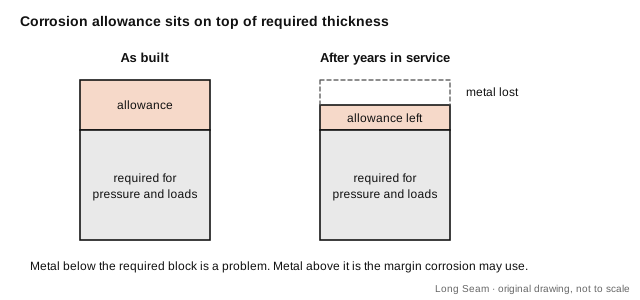
The two terms
Required (minimum) thickness comes from the pressure and load calculation. It depends on the design pressure, diameter, material strength, joint efficiency and any other loads. It is the thinnest wall that is acceptable for the conditions.
Corrosion allowance is added at the design stage because the designer expects corrosion. The vessel is built thicker than the calculation requires, and the additional metal is meant to be consumed over its design life. It is a design margin for corrosion, not a safety factor on strength.
A vessel built with a corrosion allowance therefore has nominal thickness = required thickness + corrosion allowance (plus any manufacturing tolerance or extra the fabricator chose to supply).
Try one question
Question 1 of the free 10-question check on API 510. No signup.
IV. Practical knowledge - general
Which hydrotest situation carries the highest brittle fracture risk?
Choose an answer to begin
What changes in service
In service, the question is no longer how much allowance was specified. The question is how much metal is above the required thickness today.
- Allowance remaining is the current measured thickness minus the required thickness. If corrosion has used up part of the allowance, only that remains.
- Using up the allowance is not a failure. It is what the allowance is for.
- Going below the required thickness is the problem. At that point the wall no longer meets the calculation, and the component needs to be rerated, repaired or retired. Inspection records the loss so this can be caught before it happens.
- The required thickness itself can change. If the pressure, temperature or other conditions change, the calculation changes. The inspector uses the required thickness for current conditions.
The remaining life calculation is exactly this gap divided by the corrosion rate.
Ask Patch before you buy AI your Long Seam study buddy
See what's on the API 510 exam, take the free 10-question check, or find the plan that fits you.
The API 510 course
Available now · instant accessLearn every Body of Knowledge section, work the calculations step by step, then prove it on timed exams.
- 8modules of lessonsEvery task on the outline
- 2full-length timed exams170 questions in 390 minutes each
- 481practice questionsEach one explained
- 6worked calculationsStep by step
- 1week-by-week study planSet to your exam date
Turn a practice answer into a study step. In untimed practice, ask Patch AI about any question you answer, follow up, then see your weakest topics and what to drill next.
Instant access. Terms and refunds · Secure checkout by Stripe
Every answer comes with a full explanation.
Mix-ups to avoid
- Nominal thickness versus required thickness. Nominal is what was ordered or built. Required is what is needed. Remaining life uses required, not nominal.
- Corrosion allowance versus retirement thickness. The allowance is a design addition. The retirement thickness is the thickness at which a component must come out of service, and it is based on the required thickness.
- Corrosion allowance versus strength margin. The allowance protects against metal loss. It does not make the wall stronger at the start.
On the API exam
Thickness terms feed the calculations that sit under API 510 Section 7 and the construction code. Stems may give nominal thickness, corrosion allowance and a reading, and ask for the metal remaining or for the required thickness at a given pressure. The thickness formulas are in the API 510 formula sheet in our own notation, and you confirm the constants in your own copy of the code.
Practice it
Calculate required thickness for a shell or head with the MAWP and minimum thickness calculator. Compare it with Remaining life and Short-term vs long-term corrosion rate, or browse every term in the damage mechanism glossary.
Know the mechanisms? Check the rest of the Body of Knowledge
Take the free 10-question check. It is spread across the Body of Knowledge, needs no signup and explains every answer, so you see which domains to open first. The Long Seam course then adds a lesson for each domain, timed practice exams and a study plan from your exam date.
Sources
Show the list
- API 510 Exam Publications Effectivity Sheet, September 2026, January 2027 and May 2027, American Petroleum Institute
- API 510 Body of Knowledge, September 2026, January 2027 and May 2027, American Petroleum Institute
- API 510 Pressure Vessel Inspector: exam information, American Petroleum Institute
- API 510, Pressure Vessel Inspection Code, section 7 (evaluation of inspection findings). Cited by number only; read it in your own copy.
Facts checked 25 October 2026 against the sources listed above. If something has changed, tell us and we will correct it within 2 business days.
Your next step
Ready to see where you stand on API 510?
Free, untimed and scored by domain. No signup.
Start the free 10-question checkAPI 510 course. Lessons, timed practice exams and a plan around your exam date. Get API 510 course · $199 See the plans or read the free sample lesson.Terms and refunds