Caustic vs amine stress corrosion cracking: what it means for the inspector
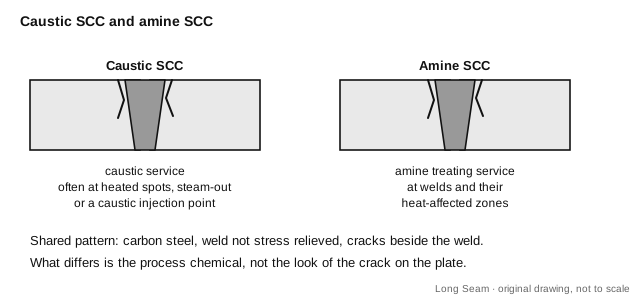
Caustic SCC and amine SCC are two forms of stress corrosion cracking that attack carbon steel, most often at welds that were not stress relieved. Caustic SCC comes from caustic (sodium hydroxide) service, amine SCC from amine treating service. The cracks look alike, so the process chemical tells you which one you have.
How it works
Both mechanisms follow the same pattern as other SCC types: carbon steel (the susceptible material), tensile stress (frequently residual weld stress) and a specific environment. For caustic SCC the environment is a hot caustic solution. For amine SCC it is an amine solution used in gas treating.
The residual stress from welding is the shared factor. A weld that has been through post-weld heat treatment (stress relief) has much less locked-in stress, and that is why stress relief is the standard defence against both mechanisms. Welds that were not stress relieved, and the heat-affected zone beside them, are where cracks begin. The cracks usually run parallel to the weld, in the base metal next to it, and they are often a network of fine cracks.
Try one question
Question 1 of the free 10-question check on API 510. No signup.
IV. Practical knowledge - general
Which hydrotest situation carries the highest brittle fracture risk?
Choose an answer to begin
Where each one shows
- Caustic SCC. Caustic is used and injected in several refinery and chemical processes. Cracking is associated with places where caustic concentrates, such as near heated surfaces, steam tracing or steam-out, and at injection points. The caustic concentrate is what does the damage, so a dilute solution in a cool line can be a much lower risk than a hot, concentrated one.
- Amine SCC. Amine treating units remove acid gas, and cracking is found in carbon steel in that service, again at welds and heat-affected zones that were not stress relieved.
Ask Patch before you buy AI your Long Seam study buddy
See what's on the API 510 exam, take the free 10-question check, or find the plan that fits you.
The API 510 course
Available now · instant accessLearn every Body of Knowledge section, work the calculations step by step, then prove it on timed exams.
- 8modules of lessonsEvery task on the outline
- 2full-length timed exams170 questions in 390 minutes each
- 481practice questionsEach one explained
- 6worked calculationsStep by step
- 1week-by-week study planSet to your exam date
Turn a practice answer into a study step. In untimed practice, ask Patch AI about any question you answer, follow up, then see your weakest topics and what to drill next.
Instant access. Terms and refunds · Secure checkout by Stripe
Every answer comes with a full explanation.
How the cracks are found
Both forms are found with wet fluorescent magnetic particle testing on cleaned weld surfaces, because the steel is magnetic and the method is sensitive to tight cracks. Angle-beam UT helps judge crack depth. Liquid penetrant testing is less reliable for these cracks, since they can be tight and filled with scale. Preparing the surface properly before examination is part of getting a reliable result.
Mix-ups to avoid
- Caustic versus amine. Same metal, same weld stress, same crack pattern. The service tells you which name applies, so read the stem for the chemical.
- Either one versus chloride SCC. Chloride SCC attacks stainless steel, not carbon steel.
- Caustic SCC versus caustic corrosion. RP 571 has both. Caustic corrosion (paragraph 3.14) is local thinning or gouging where caustic concentrates. Caustic SCC (3.15) is cracking.
On the API exam
API's effectivity sheet for September 2026 to May 2027 limits RP 571 questions to Section 2 plus 15 mechanism paragraphs. Both are on it: amine SCC is paragraph 3.3 and caustic SCC is paragraph 3.15. Questions usually give the service and the weld condition and ask for the mechanism or the preferred examination method. See the broader pattern on the stress corrosion cracking page.
Practice it
Work through a caustic and an amine scenario on the API 510 damage mechanism quiz. Compare it with Stress corrosion cracking and Chloride stress corrosion cracking, or browse every term in the damage mechanism glossary.
Know the mechanisms? Check the rest of the Body of Knowledge
Take the free 10-question check. It is spread across the Body of Knowledge, needs no signup and explains every answer, so you see which domains to open first. The Long Seam course then adds a lesson for each domain, timed practice exams and a study plan from your exam date.
Sources
Show the list
- API 510 Exam Publications Effectivity Sheet, September 2026, January 2027 and May 2027, American Petroleum Institute
- API 510 Body of Knowledge, September 2026, January 2027 and May 2027, American Petroleum Institute
- API 510 Pressure Vessel Inspector: exam information, American Petroleum Institute
- API RP 571, Damage Mechanisms Affecting Fixed Equipment in the Refining Industry, 3rd edition, March 2020, paragraph 3.3 and 3.15. Cited by number only; read it in your own copy.
Facts checked 25 October 2026 against the sources listed above. If something has changed, tell us and we will correct it within 2 business days.
Your next step
Ready to see where you stand on API 510?
Free, untimed and scored by domain. No signup.
Start the free 10-question checkAPI 510 course. Lessons, timed practice exams and a plan around your exam date. Get API 510 course · $199 See the plans or read the free sample lesson.Terms and refunds