Chloride stress corrosion cracking: what it means for the inspector
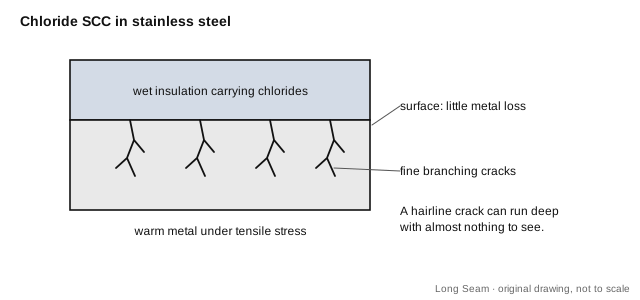
Chloride stress corrosion cracking is cracking of austenitic stainless steel exposed to chlorides while the metal is warm and under tensile stress. The cracks are fine and branching, and they can run deep with little metal loss on the surface, which makes them easy to miss without a surface crack test.
How it works
Austenitic (300-series) stainless steels resist general corrosion well, but they are vulnerable to cracking in chloride-bearing water when the metal is warm and under tensile stress. All three SCC conditions are met: a susceptible material, stress, and a specific environment (see stress corrosion cracking).
Chlorides arrive in many ways: process water, cooling water, seawater, and chlorides leached from insulation. Temperature matters because the cracking is far more likely at elevated metal temperature than at ambient, and stress usually comes from welding, bending or pressure. The cracks start at the surface, often at pits or crevices, and spread in a branching, tree-like pattern, mostly across the grains.
The damage does not look like corrosion. The wall is not visibly thinned, and a leak may be the first sign that anything is wrong.
Try one question
Question 1 of the free 10-question check on API 510. No signup.
IV. Practical knowledge - general
Which hydrotest situation carries the highest brittle fracture risk?
Choose an answer to begin
Where it shows and how it is found
- Under insulation and jacketing. Wet insulation carrying chlorides against warm stainless steel is a well-known setup, which links this mechanism to corrosion under insulation. The insulation must come off, at least at selected spots, to examine the metal.
- Crevices and deposits. Gaps under supports, at tubesheets and beneath deposits let chlorides concentrate.
- Heat exchanger tubes. Eddy current testing is used on tubing.
- Surface methods. Liquid penetrant testing is the practical method for stainless steel, because stainless steel is not magnetic and magnetic particle testing does not apply to it. Angle-beam UT can help size a crack.
Ask Patch before you buy AI your Long Seam study buddy
See what's on the API 510 exam, take the free 10-question check, or find the plan that fits you.
The API 510 course
Available now · instant accessLearn every Body of Knowledge section, work the calculations step by step, then prove it on timed exams.
- 8modules of lessonsEvery task on the outline
- 2full-length timed exams170 questions in 390 minutes each
- 481practice questionsEach one explained
- 6worked calculationsStep by step
- 1week-by-week study planSet to your exam date
Turn a practice answer into a study step. In untimed practice, ask Patch AI about any question you answer, follow up, then see your weakest topics and what to drill next.
Instant access. Terms and refunds · Secure checkout by Stripe
Every answer comes with a full explanation.
Mix-ups to avoid
- Chloride SCC versus caustic and amine SCC. Those attack carbon steel. Chloride SCC attacks austenitic stainless steel.
- Chloride SCC versus pitting. Chlorides also cause pitting in stainless steel. Pitting is a hole-forming attack with metal loss. SCC is cracking.
- Choosing the method. Because the base metal is not magnetic, penetrant testing, not magnetic particle, is the usual surface method for the cracks.
On the API exam
API's effectivity sheet for September 2026 to May 2027 limits RP 571 questions to Section 2 plus 15 mechanism paragraphs. Chloride SCC is RP 571 paragraph 3.17 and is one of the 15. Look for the clue pair of 300-series stainless steel and a chloride source, often with insulation, warmth and a weld or crevice. The Body of Knowledge also covers the examination method side, so connect each cracking mechanism with its method.
Practice it
See where chloride SCC sits among the 15 mechanisms in the API 571 damage mechanisms list for API 510. Compare it with Stress corrosion cracking and Corrosion under insulation, or browse every term in the damage mechanism glossary.
Know the mechanisms? Check the rest of the Body of Knowledge
Take the free 10-question check. It is spread across the Body of Knowledge, needs no signup and explains every answer, so you see which domains to open first. The Long Seam course then adds a lesson for each domain, timed practice exams and a study plan from your exam date.
Sources
Show the list
- API 510 Exam Publications Effectivity Sheet, September 2026, January 2027 and May 2027, American Petroleum Institute
- API 510 Body of Knowledge, September 2026, January 2027 and May 2027, American Petroleum Institute
- API 510 Pressure Vessel Inspector: exam information, American Petroleum Institute
- API RP 571, Damage Mechanisms Affecting Fixed Equipment in the Refining Industry, 3rd edition, March 2020, paragraph 3.17. Cited by number only; read it in your own copy.
Facts checked 25 October 2026 against the sources listed above. If something has changed, tell us and we will correct it within 2 business days.
Your next step
Ready to see where you stand on API 510?
Free, untimed and scored by domain. No signup.
Start the free 10-question checkAPI 510 course. Lessons, timed practice exams and a plan around your exam date. Get API 510 course · $199 See the plans or read the free sample lesson.Terms and refunds