General vs localized corrosion: what it means for the inspector
General corrosion removes metal fairly evenly across a surface, so the wall gets thinner as a whole. Localized corrosion attacks small areas, as pits, grooves or patches, while the rest of the surface is largely untouched. The difference decides how you take readings, how you rate the damage, and how long a component can run.
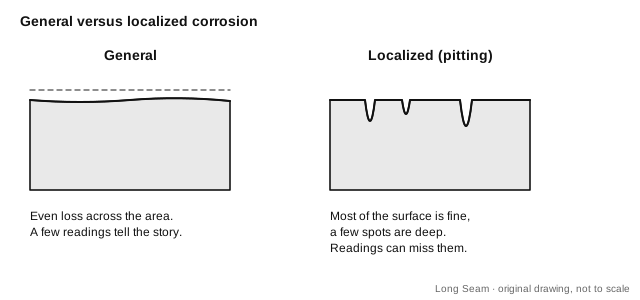
How they differ
General (uniform) corrosion spreads over the whole surface. The thickness is lower everywhere by about the same amount. Because the loss is even, a handful of thickness readings is a good picture of the whole, and a straight-line rate through the readings is a fair way to predict where the wall is going.
Localized corrosion is concentrated. Pitting makes small deep holes. Grooving follows a weld or a flow path. Patches or local thin areas form where something special happens, such as a leak, a deposit or a flow pattern. Most of the surface can be close to its original thickness while a small spot is nearly through.
Try one question
Question 1 of the free 10-question check on API 510. No signup.
IV. Practical knowledge - general
Which hydrotest situation carries the highest brittle fracture risk?
Choose an answer to begin
Why it changes the inspection
- Where you read matters more. With general loss, a few readings are representative. With localized loss, readings that miss the bad spot give a false sense of safety. Grids, scans and visual examination of the surface are used to find the worst point.
- Which number you use. For general loss you can use the average thickness. For a localized area, the thinnest point in that area is what counts, and the code has separate rules for judging local thin areas and pitting that you read in your own copy.
- Rate prediction. Pits can grow much faster than the general loss rate, so a low average rate is not a promise about the deepest pit.
- The cause. General loss points to a broad cause such as a corrosive process fluid. Local loss points to something specific: a flow pattern, a deposit, an interface, a weld or microbial activity.
Ask Patch before you buy AI your Long Seam study buddy
See what's on the API 510 exam, take the free 10-question check, or find the plan that fits you.
The API 510 course
Available now · instant accessLearn every Body of Knowledge section, work the calculations step by step, then prove it on timed exams.
- 8modules of lessonsEvery task on the outline
- 2full-length timed exams170 questions in 390 minutes each
- 481practice questionsEach one explained
- 6worked calculationsStep by step
- 1week-by-week study planSet to your exam date
Turn a practice answer into a study step. In untimed practice, ask Patch AI about any question you answer, follow up, then see your weakest topics and what to drill next.
Instant access. Terms and refunds · Secure checkout by Stripe
Every answer comes with a full explanation.
Mix-ups to avoid
- General versus atmospheric corrosion. Atmospheric corrosion is a cause (exposure to weather). It can look general or local. General versus local describes the shape of the damage, not the cause.
- Pitting versus cracking. A pit is a small hole with metal loss. A crack is a thin planar break with almost none. They need different methods.
- Local versus uniform erosion. Wear at a bend, as in erosion-corrosion, is local by design.
On the API exam
This is a way of thinking about damage, not one RP 571 paragraph. It shows up in how questions use the words thinning, pitting and local thin area, and in calculation stems that give you several readings and ask which one to use. The habit to build is to look at the pattern first (even or local), then choose the method and the thickness that match.
Practice it
Try a set of readings in the thickness survey analyzer and see how a single bad point changes the rate. Compare it with Erosion-corrosion and Microbiologically influenced corrosion, or browse every term in the damage mechanism glossary.
Know the mechanisms? Check the rest of the Body of Knowledge
Take the free 10-question check. It is spread across the Body of Knowledge, needs no signup and explains every answer, so you see which domains to open first. The Long Seam course then adds a lesson for each domain, timed practice exams and a study plan from your exam date.
Sources
Show the list
- API 510 Exam Publications Effectivity Sheet, September 2026, January 2027 and May 2027, American Petroleum Institute
- API 510 Body of Knowledge, September 2026, January 2027 and May 2027, American Petroleum Institute
- API 510 Pressure Vessel Inspector: exam information, American Petroleum Institute
- API RP 571, Damage Mechanisms Affecting Fixed Equipment in the Refining Industry, 3rd edition, March 2020. Read the matching paragraph in your own copy.
Facts checked 25 October 2026 against the sources listed above. If something has changed, tell us and we will correct it within 2 business days.
Your next step
Ready to see where you stand on API 510?
Free, untimed and scored by domain. No signup.
Start the free 10-question checkAPI 510 course. Lessons, timed practice exams and a plan around your exam date. Get API 510 course · $199 See the plans or read the free sample lesson.Terms and refunds