Remaining life: what it means for the inspector
Remaining life is the estimate of how many more years a component can run before corrosion takes its wall down to the required thickness. It is found by dividing the metal still available above that thickness by the corrosion rate. It is a projection, not a promise, and it is only as good as the rate behind it.
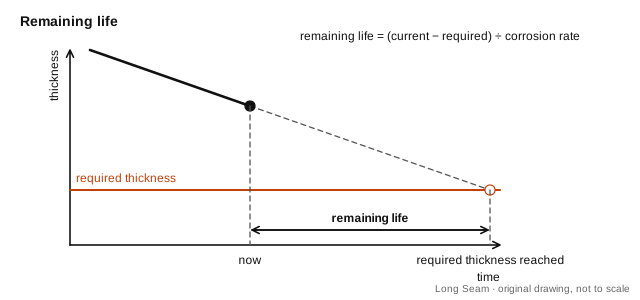
The calculation
Remaining life = (current thickness - required thickness) / corrosion rate
- Current thickness is the most recent reliable reading, at the worst location.
- Required thickness is the thickness the component needs for its pressure and loads, calculated from the construction code with the conditions that apply. It is not the nominal thickness and not the original thickness.
- Corrosion rate is the chosen rate for that location. See short-term versus long-term rate for how that choice is made.
Try one question
Question 1 of the free 10-question check on API 510. No signup.
IV. Practical knowledge - general
Which hydrotest situation carries the highest brittle fracture risk?
Choose an answer to begin
A worked example (invented numbers)
A nozzle neck read 0.412 in. at the last inspection. The required thickness is 0.300 in. and the chosen corrosion rate is 0.009 in. per year.
- Metal available: 0.412 - 0.300 = 0.112 in.
- Remaining life: 0.112 / 0.009 = about 12.4 years.
If the rate were 0.014 in. per year instead, the same wall would have 0.112 / 0.014 = 8.0 years. The thickness did not change, only the rate did, which shows how sensitive the result is to that choice.
Ask Patch before you buy AI your Long Seam study buddy
See what's on the API 510 exam, take the free 10-question check, or find the plan that fits you.
The API 510 course
Available now · instant accessLearn every Body of Knowledge section, work the calculations step by step, then prove it on timed exams.
- 8modules of lessonsEvery task on the outline
- 2full-length timed exams170 questions in 390 minutes each
- 481practice questionsEach one explained
- 6worked calculationsStep by step
- 1week-by-week study planSet to your exam date
Turn a practice answer into a study step. In untimed practice, ask Patch AI about any question you answer, follow up, then see your weakest topics and what to drill next.
Instant access. Terms and refunds · Secure checkout by Stripe
Every answer comes with a full explanation.
What remaining life is not
- It is not the inspection interval. The next inspection is set separately, using the remaining life along with maximum interval limits in the code. API 510 deals with intervals in Section 6, and the inspection interval calculator works through it. A component with a long remaining life still gets inspected on a schedule.
- It is not the time to failure. The calculation ends when the wall reaches the required thickness, which includes a design margin, so it is not the time to a leak.
- It is not reliable if the rate is wrong. Pitting, a process change or readings that missed the worst spot can all make the result optimistic.
Mix-ups to avoid
- Required versus minimum thickness for the design. The required thickness is what is needed for pressure and loads. Corrosion allowance sits on top of it.
- Using the wrong location. The shortest remaining life among all locations governs the component.
- Units. Keep inches and years, or millimetres and years, throughout.
On the API exam
Remaining life is a core calculation area in the Body of Knowledge. API 510 paragraph 7.4 is where the Body of Knowledge points for metal loss, 7.1 for corrosion rate and 7.2 for remaining life, with Section 6 for the interval that follows. Stems give readings and ask you to work through rate, remaining life, or both. Keep the steps in order: metal available, then the rate, then the time. The API 510 calculations guide lists all the calculation areas.
Practice it
Check your own working with the remaining life calculator. Compare it with Short-term vs long-term corrosion rate and Corrosion allowance vs minimum thickness, or browse every term in the damage mechanism glossary.
Know the mechanisms? Check the rest of the Body of Knowledge
Take the free 10-question check. It is spread across the Body of Knowledge, needs no signup and explains every answer, so you see which domains to open first. The Long Seam course then adds a lesson for each domain, timed practice exams and a study plan from your exam date.
Sources
Show the list
- API 510 Exam Publications Effectivity Sheet, September 2026, January 2027 and May 2027, American Petroleum Institute
- API 510 Body of Knowledge, September 2026, January 2027 and May 2027, American Petroleum Institute
- API 510 Pressure Vessel Inspector: exam information, American Petroleum Institute
- API 510, Pressure Vessel Inspection Code, section 7 (evaluation of inspection findings). Cited by number only; read it in your own copy.
Facts checked 25 October 2026 against the sources listed above. If something has changed, tell us and we will correct it within 2 business days.
Your next step
Ready to see where you stand on API 510?
Free, untimed and scored by domain. No signup.
Start the free 10-question checkAPI 510 course. Lessons, timed practice exams and a plan around your exam date. Get API 510 course · $199 See the plans or read the free sample lesson.Terms and refunds