Mechanical fatigue: what it means for the inspector
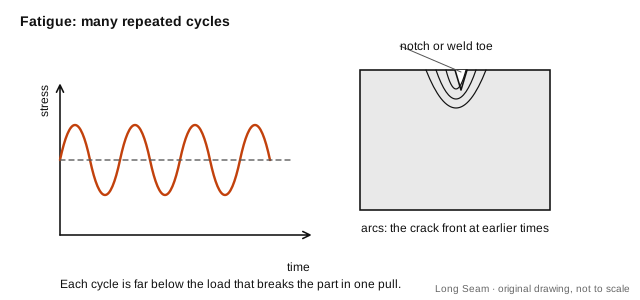
Mechanical fatigue is cracking caused by repeated stress cycles, each one far below what would break the part in a single pull. A crack starts at a stress concentration such as a notch or weld toe and grows a little every cycle. Vibration and pressure or load cycling are the usual sources.
How it works
A part loaded once, below its strength, carries the load. A part loaded and unloaded thousands or millions of times can crack even though no single cycle is large. Three things control fatigue life: the size of the stress swing, the number of cycles, and the stress concentration at the spot where a crack can start.
Fatigue has stages. A crack starts at a stress concentrator such as a sharp notch, a weld toe, a poor-fitting weld, a surface scratch or a small bore connection. It grows a small step each cycle. Finally the remaining wall can no longer carry the load, and the part fails, sometimes suddenly. The fracture surface often shows curved marks (beach marks) where the crack paused or changed pace, with a rough final-fracture region.
Try one question
Question 1 of the free 10-question check on API 510. No signup.
IV. Practical knowledge - general
Which hydrotest situation carries the highest brittle fracture risk?
Choose an answer to begin
Sources of cycling
- Vibration. Pumps, compressors and flow-induced vibration shake attached piping. Small-bore connections, branch connections and unsupported pipe are common victims.
- Pressure and thermal cycling. Repeated start-ups, shutdowns and load swings cycle the stress. Thermal fatigue, from repeated temperature swings, is a related form.
- External loads. Wind, mechanical movement or equipment loads on supports and attachments.
Ask Patch before you buy AI your Long Seam study buddy
See what's on the API 510 exam, take the free 10-question check, or find the plan that fits you.
The API 510 course
Available now · instant accessLearn every Body of Knowledge section, work the calculations step by step, then prove it on timed exams.
- 8modules of lessonsEvery task on the outline
- 2full-length timed exams170 questions in 390 minutes each
- 481practice questionsEach one explained
- 6worked calculationsStep by step
- 1week-by-week study planSet to your exam date
Turn a practice answer into a study step. In untimed practice, ask Patch AI about any question you answer, follow up, then see your weakest topics and what to drill next.
Instant access. Terms and refunds · Secure checkout by Stripe
Every answer comes with a full explanation.
Where it shows and how it is found
Cracks form at welds and attachments, so inspection concentrates there. Wet fluorescent magnetic particle testing finds surface cracks in magnetic steel, and penetrant testing handles other metals. UT can look at depth. A good field inspector also looks for the cause: loose supports, missing bracing, vibrating small-bore piping, and anything that suggests unusual movement. Fixing the cause matters more than welding the crack.
Mix-ups to avoid
- Fatigue versus creep. Fatigue needs cycling. Creep needs steady load and high temperature.
- Fatigue versus stress corrosion cracking. SCC needs a chemical environment and works under static stress. Fatigue does not need a chemical, though corrosion can speed it up (corrosion fatigue).
- Fatigue versus brittle fracture. Fatigue is a slow, repeated build-up. Brittle fracture is a single sudden event in cold steel.
On the API exam
Mechanical fatigue (RP 571 paragraph 3.43, which covers vibration-induced fatigue) was on API's list for the September 2024 to May 2025 windows but is not one of the 15 paragraphs on the sheet for September 2026 to May 2027. Questions on RP 571 for API 510 come only from the listed portions, so treat this as background and check the sheet for your window. The idea still helps you reason about cracking at supports and small-bore connections.
Practice it
See what is and is not on the RP 571 list for your window in the API 571 damage mechanisms list for API 510. Compare it with Brittle fracture and Creep, or browse every term in the damage mechanism glossary.
Know the mechanisms? Check the rest of the Body of Knowledge
Take the free 10-question check. It is spread across the Body of Knowledge, needs no signup and explains every answer, so you see which domains to open first. The Long Seam course then adds a lesson for each domain, timed practice exams and a study plan from your exam date.
Sources
Show the list
- API 510 Exam Publications Effectivity Sheet, September 2026, January 2027 and May 2027, American Petroleum Institute
- API 510 Body of Knowledge, September 2026, January 2027 and May 2027, American Petroleum Institute
- API 510 Pressure Vessel Inspector: exam information, American Petroleum Institute
- API RP 571, Damage Mechanisms Affecting Fixed Equipment in the Refining Industry, 3rd edition, March 2020. Read the matching paragraph in your own copy.
Facts checked 25 October 2026 against the sources listed above. If something has changed, tell us and we will correct it within 2 business days.
Your next step
Ready to see where you stand on API 510?
Free, untimed and scored by domain. No signup.
Start the free 10-question checkAPI 510 course. Lessons, timed practice exams and a plan around your exam date. Get API 510 course · $199 See the plans or read the free sample lesson.Terms and refunds