Corrosion under insulation: what it means for the inspector
Corrosion under insulation (CUI) is metal loss on the outside of insulated equipment, caused by water that gets beneath the insulation and stays against the steel. The insulation and its jacket hide the damage, so a vessel or pipe can look sound from outside while the wall underneath keeps thinning.
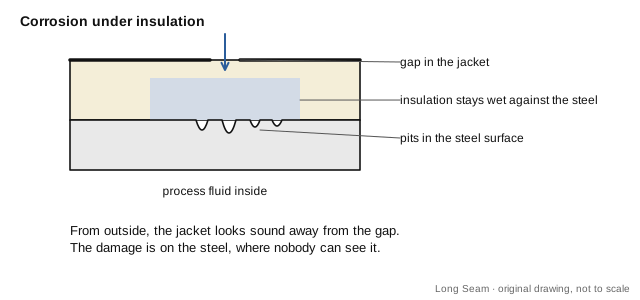
How it works
Insulation keeps heat in or out. It is not built to keep water out for decades. Water reaches the steel through jacket seams, damaged sealant, penetrations such as nozzles and supports, and from rain, wash-down or leaking steam tracing. Once inside, the insulation acts like a sponge, holding moisture against the metal with little chance to dry.
Three things make the damage worse. The first is time: a small leak that goes unrepaired for years has years of wetting to work with. The second is temperature. Equipment that runs hot enough to dry its insulation completely is less exposed, while equipment that runs cool, or that cycles between hot and cold, spends more time with liquid water against the metal. The third is the steel's coating. Paint and other coatings age, and bare or poorly coated steel under wet insulation corrodes freely.
The damage on carbon steel is usually thinning, general or patchy. On austenitic stainless steel the concern is different, because chlorides washed out of the insulation can cause chloride stress corrosion cracking instead of simple wall loss.
Try one question
Question 1 of the free 10-question check on API 510. No signup.
IV. Practical knowledge - general
Which hydrotest situation carries the highest brittle fracture risk?
Choose an answer to begin
Where it shows and how it is found
You cannot see CUI from outside, so the work is deciding where to look and then looking.
- Read the jacket. Damaged or missing sealant, dented or open seams, stains, rust streaks and bulges all point to water getting in.
- Think about where water collects. Low points, the bottom of a vessel, nozzle and support penetrations, ladder and platform clips, and any place where jacketing is cut or fitted around something are the usual candidates.
- Open it up. Inspectors remove insulation at selected spots to see the steel directly. Where stripping everything is impractical, techniques such as profile radiography or ultrasonic thickness readings help decide where to strip and how bad it is.
Our post on what inspectors look for with corrosion under insulation goes through the locations and warning signs in more detail. This page is about why the damage hides and how to separate it from look-alikes.
Ask Patch before you buy AI your Long Seam study buddy
See what's on the API 510 exam, take the free 10-question check, or find the plan that fits you.
The API 510 course
Available now · instant accessLearn every Body of Knowledge section, work the calculations step by step, then prove it on timed exams.
- 8modules of lessonsEvery task on the outline
- 2full-length timed exams170 questions in 390 minutes each
- 481practice questionsEach one explained
- 6worked calculationsStep by step
- 1week-by-week study planSet to your exam date
Turn a practice answer into a study step. In untimed practice, ask Patch AI about any question you answer, follow up, then see your weakest topics and what to drill next.
Instant access. Terms and refunds · Secure checkout by Stripe
Every answer comes with a full explanation.
Mix-ups to avoid
- CUI versus atmospheric corrosion. Atmospheric corrosion attacks exposed, painted or bare surfaces you can see. CUI is under cladding you cannot see through. The cause is similar (moisture and oxygen), but the inspection problem is different.
- CUI versus corrosion from the process side. CUI starts on the outside surface. If the wall is thinning from the inside, look at process-side mechanisms instead.
- Thinning versus cracking. On carbon steel, expect wall loss. On stainless steel, expect that wet insulation may also cause cracks with very little metal loss.
On the API exam
API's effectivity sheet for September 2026 to May 2027 limits RP 571 questions to Section 2 plus 15 mechanism paragraphs. Corrosion under insulation is RP 571 paragraph 3.22 and is one of the 15. A typical stem describes an insulated line or vessel, a damaged jacket or a wet location, and asks which mechanism is likely or where to look. Practise going from the clues (insulation, water, outside surface) to the name. API 570 has its own sheet and Body of Knowledge, so check which paragraphs it lists for your window.
Practice it
Test the symptom-to-mechanism step on the API 510 damage mechanism quiz. Compare it with Chloride stress corrosion cracking and Atmospheric corrosion, or browse every term in the damage mechanism glossary.
Know the mechanisms? Check the rest of the Body of Knowledge
Take the free 10-question check. It is spread across the Body of Knowledge, needs no signup and explains every answer, so you see which domains to open first. The Long Seam course then adds a lesson for each domain, timed practice exams and a study plan from your exam date.
Sources
Show the list
- API 510 Exam Publications Effectivity Sheet, September 2026, January 2027 and May 2027, American Petroleum Institute
- API 510 Body of Knowledge, September 2026, January 2027 and May 2027, American Petroleum Institute
- API 510 Pressure Vessel Inspector: exam information, American Petroleum Institute
- API RP 571, Damage Mechanisms Affecting Fixed Equipment in the Refining Industry, 3rd edition, March 2020, paragraph 3.22. Cited by number only; read it in your own copy.
Facts checked 25 October 2026 against the sources listed above. If something has changed, tell us and we will correct it within 2 business days.
Your next step
Ready to see where you stand on API 510?
Free, untimed and scored by domain. No signup.
Start the free 10-question checkAPI 510 course. Lessons, timed practice exams and a plan around your exam date. Get API 510 course · $199 See the plans or read the free sample lesson.Terms and refunds