Microbiologically influenced corrosion: what it means for the inspector
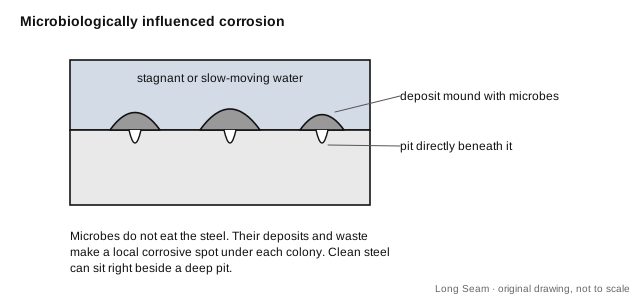
Microbiologically influenced corrosion (MIC) is corrosion that starts or speeds up because of microorganisms living on a metal surface. Colonies and the deposits they build create small local environments that corrode the metal beneath them. The usual result is pitting under mounds of deposit, in water that is stagnant or slow-moving.
How it works
Microorganisms do not eat steel. What they do is change the conditions at the surface. A colony settles, builds a film or mound of deposit, and the chemistry underneath becomes different from the bulk water. Oxygen is used up, acids or other corrosive byproducts form, and a small separate corrosion cell develops. The result is a local attack under each colony, often deep and narrow.
Several conditions favour it. Water that is stagnant or moving slowly gives microbes time to settle. Deposits, sludge and tubercles give them shelter. Equipment that is hydrotested and left wet, or idle lines with trapped water, often sets up exactly these conditions. Water temperature and nutrient content also matter, because the microbes need conditions they can live in.
Try one question
Question 1 of the free 10-question check on API 510. No signup.
IV. Practical knowledge - general
Which hydrotest situation carries the highest brittle fracture risk?
Choose an answer to begin
Where it shows and how it is found
MIC is associated with water-handling systems and with places where water collects.
- Cooling water systems, fire water lines and tanks.
- Low points, dead legs and idle equipment where water sits.
- Equipment that was hydrotested and not drained and dried promptly.
Typical signs are mounds or tubercles on the surface, slimy or crusty deposit, and pits with a distinctive shape: often a wide mouth or cup-shaped pit under the deposit, in otherwise sound metal. Inspectors clean the surface and look at the metal under the deposit, then measure pit depth with a gauge. UT readings at random spots can miss it, because the attack is so local. Chemical and biological testing of the water or the deposit can support the diagnosis, but a visual look under the deposit is often the first clue.
Ask Patch before you buy AI your Long Seam study buddy
See what's on the API 510 exam, take the free 10-question check, or find the plan that fits you.
The API 510 course
Available now · instant accessLearn every Body of Knowledge section, work the calculations step by step, then prove it on timed exams.
- 8modules of lessonsEvery task on the outline
- 2full-length timed exams170 questions in 390 minutes each
- 481practice questionsEach one explained
- 6worked calculationsStep by step
- 1week-by-week study planSet to your exam date
Turn a practice answer into a study step. In untimed practice, ask Patch AI about any question you answer, follow up, then see your weakest topics and what to drill next.
Instant access. Terms and refunds · Secure checkout by Stripe
Every answer comes with a full explanation.
Mix-ups to avoid
- MIC versus general corrosion. MIC is local and tied to colonies. General corrosion is broad.
- MIC versus condensate corrosion. Condensate corrosion is driven by dissolved gases in steam condensate. MIC is driven by deposits and organisms in water that is not necessarily acidic.
- MIC versus under-deposit corrosion in general. Not every pit under a deposit is microbial. Confirming needs deposit and water analysis, not just a look.
On the API exam
Microbiologically influenced corrosion is not among the 15 mechanism paragraphs on API's effectivity sheet for September 2026 to May 2027. API 510 questions on RP 571 come only from the listed portions, so use this page as background and for field practice. It is still worth knowing the pattern, because stagnant water, deposits and pitting under deposit come up in inspection work well beyond the exam. Check the sheet for your own window.
Practice it
Practise turning thickness readings into a rate with the thickness survey analyzer. Compare it with General vs localized corrosion and Boiler water and condensate corrosion, or browse every term in the damage mechanism glossary.
Know the mechanisms? Check the rest of the Body of Knowledge
Take the free 10-question check. It is spread across the Body of Knowledge, needs no signup and explains every answer, so you see which domains to open first. The Long Seam course then adds a lesson for each domain, timed practice exams and a study plan from your exam date.
Sources
Show the list
- API 510 Exam Publications Effectivity Sheet, September 2026, January 2027 and May 2027, American Petroleum Institute
- API 510 Body of Knowledge, September 2026, January 2027 and May 2027, American Petroleum Institute
- API 510 Pressure Vessel Inspector: exam information, American Petroleum Institute
- API RP 571, Damage Mechanisms Affecting Fixed Equipment in the Refining Industry, 3rd edition, March 2020. Read the matching paragraph in your own copy.
Facts checked 25 October 2026 against the sources listed above. If something has changed, tell us and we will correct it within 2 business days.
Your next step
Ready to see where you stand on API 510?
Free, untimed and scored by domain. No signup.
Start the free 10-question checkAPI 510 course. Lessons, timed practice exams and a plan around your exam date. Get API 510 course · $199 See the plans or read the free sample lesson.Terms and refunds