Sulfidation: what it means for the inspector
Sulfidation is the thinning of carbon and low-alloy steel by sulfur compounds in a hot process stream. The sulfur reacts with the iron in the steel and forms a sulfide scale, and over time the wall gets thinner. It is a high-temperature mechanism, so it belongs to hot units, not cool lines.
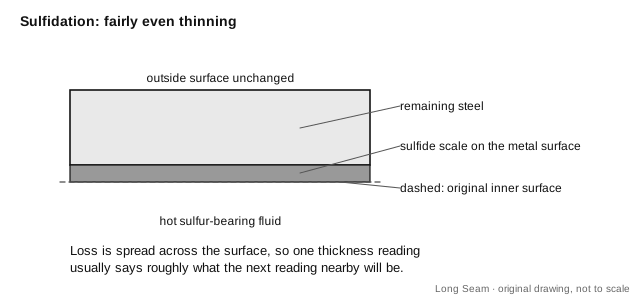
How it works
At high metal temperatures, sulfur compounds in a process stream react directly with iron. No water is needed. The reaction forms an iron sulfide layer on the surface, and the metal under it is consumed. The layer is not a reliable shield, so the attack carries on as long as the conditions do.
Three factors drive how fast it goes. The first is temperature: the hotter the metal, the faster the reaction. The second is the sulfur content and form in the stream. The third is the alloy. Chromium in the steel makes a more protective scale, so steels with more chromium resist sulfidation much better than plain carbon steel. That is why a carbon steel component sitting in a line otherwise built from a more resistant alloy can thin much faster than its neighbours.
Try one question
Question 1 of the free 10-question check on API 510. No signup.
IV. Practical knowledge - general
Which hydrotest situation carries the highest brittle fracture risk?
Choose an answer to begin
Where it shows and how it is found
Sulfidation typically looks like fairly even thinning across a surface, though it can be uneven where flow is high or where the alloy differs. It turns up in hot units that process sulfur-bearing streams, in heaters, piping and vessels.
- Thickness readings are the main tool. UT thickness at fixed monitoring locations, read at intervals, gives you a trend. Because the loss tends to be broad, repeated readings at the same locations are often a good guide.
- Check the material. Because alloy content changes the rate so much, positive material identification (PMI) is used to confirm that a component is the alloy the records say it is. A mismatch can explain a fast thin spot.
- Look at the scale. When surfaces are open for inspection, sulfide scale on the metal is a clue.
Ask Patch before you buy AI your Long Seam study buddy
See what's on the API 510 exam, take the free 10-question check, or find the plan that fits you.
The API 510 course
Available now · instant accessLearn every Body of Knowledge section, work the calculations step by step, then prove it on timed exams.
- 8modules of lessonsEvery task on the outline
- 2full-length timed exams170 questions in 390 minutes each
- 481practice questionsEach one explained
- 6worked calculationsStep by step
- 1week-by-week study planSet to your exam date
Turn a practice answer into a study step. In untimed practice, ask Patch AI about any question you answer, follow up, then see your weakest topics and what to drill next.
Instant access. Terms and refunds · Secure checkout by Stripe
Every answer comes with a full explanation.
Mix-ups to avoid
- Sulfidation versus high-temperature hydrogen attack. Sulfidation thins the wall from the surface. Hydrogen attack damages the inside of the wall while the surface looks fine.
- Sulfidation versus wet H2S damage. Wet H2S damage needs liquid water and happens at lower temperatures, and it cracks or blisters the steel. Sulfidation is hot and dry and thins it.
- Sulfidation versus naphthenic acid corrosion. Both occur in hot oil. Naphthenic acid attack is usually local and tied to velocity, while sulfidation is more even and tied to sulfur and alloy.
On the API exam
API's effectivity sheet for September 2026 to May 2027 limits RP 571 questions to Section 2 plus 15 mechanism paragraphs. Sulfidation is RP 571 paragraph 3.61 and is one of the 15. Expect a stem with a hot, sulfur-bearing service, carbon or low-alloy steel and thinning, and be ready for the idea that the wrong alloy in one component explains an unusual thin spot. The numbers (temperatures, corrosion rate curves) live in RP 571 itself, so read them there in your own copy rather than from a summary.
Practice it
The one-line notes on all 15 sheet mechanisms are in the API 571 damage mechanisms list for API 510. Compare it with High-temperature hydrogen attack and Naphthenic acid corrosion, or browse every term in the damage mechanism glossary.
Know the mechanisms? Check the rest of the Body of Knowledge
Take the free 10-question check. It is spread across the Body of Knowledge, needs no signup and explains every answer, so you see which domains to open first. The Long Seam course then adds a lesson for each domain, timed practice exams and a study plan from your exam date.
Sources
Show the list
- API 510 Exam Publications Effectivity Sheet, September 2026, January 2027 and May 2027, American Petroleum Institute
- API 510 Body of Knowledge, September 2026, January 2027 and May 2027, American Petroleum Institute
- API 510 Pressure Vessel Inspector: exam information, American Petroleum Institute
- API RP 571, Damage Mechanisms Affecting Fixed Equipment in the Refining Industry, 3rd edition, March 2020, paragraph 3.61. Cited by number only; read it in your own copy.
Facts checked 25 October 2026 against the sources listed above. If something has changed, tell us and we will correct it within 2 business days.
Your next step
Ready to see where you stand on API 510?
Free, untimed and scored by domain. No signup.
Start the free 10-question checkAPI 510 course. Lessons, timed practice exams and a plan around your exam date. Get API 510 course · $199 See the plans or read the free sample lesson.Terms and refunds