Naphthenic acid corrosion: what it means for the inspector
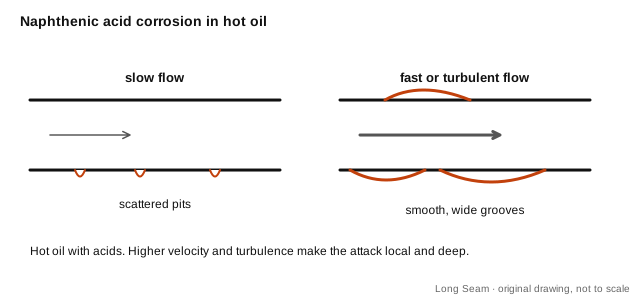
Naphthenic acid corrosion is metal loss caused by organic acids found in some crude oils, attacking steel in hot crude and vacuum units. It needs no water. It is local, often showing as pits or smooth grooves, and it is worse where the oil is moving fast or churning, such as at bends, nozzles and transfer lines.
How it works
Some crude oils contain naphthenic acids, a family of organic carboxylic acids. At high temperature, in the oil with no water present, these acids react with the steel and form iron salts that dissolve in the oil. The metal is carried away rather than building up in a protective scale, so the surface stays clean and the attack continues.
Several factors set how bad it gets: the acid content of the crude, the temperature range of the equipment, the velocity and turbulence of the flow, and the alloy. Carbon steel is the most vulnerable. Stainless steels with enough molybdenum resist it better, which is why material upgrades are a standard defence in affected sections.
Velocity is the factor to remember. In slow or stagnant sections the attack tends to be pitting. Where flow is fast or turbulent, the damage becomes smooth, streamlined grooves following the flow, and the wall can thin quickly in a small area.
Try one question
Question 1 of the free 10-question check on API 510. No signup.
IV. Practical knowledge - general
Which hydrotest situation carries the highest brittle fracture risk?
Choose an answer to begin
Where it shows and how it is found
It is associated with hot crude and vacuum units: heater outlets, transfer lines, vacuum column internals, and piping at bends, tees, reducers and downstream of restrictions.
- Thickness scanning and radiography over the high-velocity locations give the best chance of catching a narrow groove.
- Process monitoring is part of the defence: changes in the crude blend change the acid load, and inspection frequency should follow.
- Material verification helps confirm that sections thought to be upgraded alloy actually are.
Ask Patch before you buy AI your Long Seam study buddy
See what's on the API 510 exam, take the free 10-question check, or find the plan that fits you.
The API 510 course
Available now · instant accessLearn every Body of Knowledge section, work the calculations step by step, then prove it on timed exams.
- 8modules of lessonsEvery task on the outline
- 2full-length timed exams170 questions in 390 minutes each
- 481practice questionsEach one explained
- 6worked calculationsStep by step
- 1week-by-week study planSet to your exam date
Turn a practice answer into a study step. In untimed practice, ask Patch AI about any question you answer, follow up, then see your weakest topics and what to drill next.
Instant access. Terms and refunds · Secure checkout by Stripe
Every answer comes with a full explanation.
Mix-ups to avoid
- Naphthenic acid corrosion versus sulfidation. Both occur in hot oil systems, and both can be present. Sulfidation is driven by sulfur compounds and tends to be more even. Naphthenic acid attack is driven by organic acids and is more local, tied to velocity.
- Naphthenic acid corrosion versus erosion-corrosion. Both look like flow-shaped wear. Erosion-corrosion works by removing the protective film; naphthenic acid attack happens because the corrosion products dissolve in the oil, so there is no film to protect the metal.
- Naphthenic acid versus hydrochloric acid corrosion. Naphthenic acid needs no water; HCl corrosion needs liquid water.
On the API exam
API's effectivity sheet for September 2026 to May 2027 limits RP 571 questions to Section 2 plus 15 mechanism paragraphs. Naphthenic acid corrosion is RP 571 paragraph 3.46 and is one of the 15. API prints it in red on the current sheet, and it was added to the RP 571 list at the September 2025 cycle. Expect a hot crude or vacuum unit, a velocity clue and local grooving or pitting. The usual question asks for the mechanism or the examination approach that best catches local loss.
Practice it
The red-marked entries on the sheet are listed in the API 571 damage mechanisms list for API 510. Compare it with Sulfidation and Erosion-corrosion, or browse every term in the damage mechanism glossary.
Know the mechanisms? Check the rest of the Body of Knowledge
Take the free 10-question check. It is spread across the Body of Knowledge, needs no signup and explains every answer, so you see which domains to open first. The Long Seam course then adds a lesson for each domain, timed practice exams and a study plan from your exam date.
Sources
Show the list
- API 510 Exam Publications Effectivity Sheet, September 2026, January 2027 and May 2027, American Petroleum Institute
- API 510 Body of Knowledge, September 2026, January 2027 and May 2027, American Petroleum Institute
- API 510 Pressure Vessel Inspector: exam information, American Petroleum Institute
- API RP 571, Damage Mechanisms Affecting Fixed Equipment in the Refining Industry, 3rd edition, March 2020, paragraph 3.46. Cited by number only; read it in your own copy.
Facts checked 25 October 2026 against the sources listed above. If something has changed, tell us and we will correct it within 2 business days.
Your next step
Ready to see where you stand on API 510?
Free, untimed and scored by domain. No signup.
Start the free 10-question checkAPI 510 course. Lessons, timed practice exams and a plan around your exam date. Get API 510 course · $199 See the plans or read the free sample lesson.Terms and refunds