Erosion-corrosion: what it means for the inspector
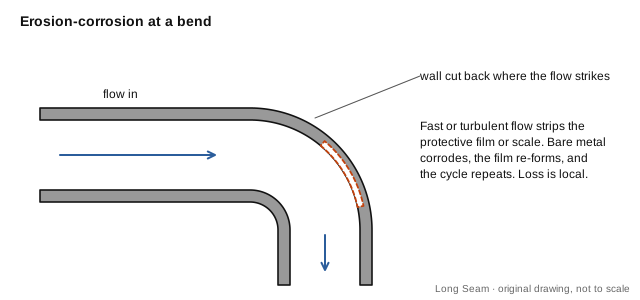
Erosion is metal loss caused by fluid or particles hitting a surface. Erosion-corrosion is the same wear combined with corrosion: moving fluid strips the protective film or scale, bare metal corrodes, a new film forms, and the cycle repeats. The result is local, often smooth wear where flow is fast or turbulent.
How it works
Pure erosion is mechanical. Liquid droplets, solid particles or high-speed flow knock metal off the surface. The effect grows with velocity, with particle content and with how sharply the flow is forced to change direction.
Erosion-corrosion adds chemistry. Many metals survive in a corrosive fluid because they build up a protective scale or film. Fast or turbulent flow keeps tearing that film away, so the fresh metal under it keeps corroding. The wall wears faster than either erosion or corrosion alone would manage. The surface is often smooth, with horseshoe-shaped or scalloped patterns, and the damage follows the flow direction.
Try one question
Question 1 of the free 10-question check on API 510. No signup.
IV. Practical knowledge - general
Which hydrotest situation carries the highest brittle fracture risk?
Choose an answer to begin
Where it shows and how it is found
Look for places where the flow speeds up, changes direction or becomes turbulent.
- Bends and elbows, especially on the outside of the turn.
- Inlet nozzles and the surface opposite them, where incoming flow strikes.
- Downstream of valves, orifices and reducers, where turbulence is high.
- Internals, such as baffles and tube ends in exchangers.
Because the loss is local, a single thickness reading can miss the worst spot. Inspectors use thickness grids or scanning, and visual examination of internals when the equipment is open. Trending the same grid points over time shows how fast the wall is moving. Our corrosion rate calculator and the thickness survey analyzer take a set of readings and give you a rate and remaining life.
Ask Patch before you buy AI your Long Seam study buddy
See what's on the API 510 exam, take the free 10-question check, or find the plan that fits you.
The API 510 course
Available now · instant accessLearn every Body of Knowledge section, work the calculations step by step, then prove it on timed exams.
- 8modules of lessonsEvery task on the outline
- 2full-length timed exams170 questions in 390 minutes each
- 481practice questionsEach one explained
- 6worked calculationsStep by step
- 1week-by-week study planSet to your exam date
Turn a practice answer into a study step. In untimed practice, ask Patch AI about any question you answer, follow up, then see your weakest topics and what to drill next.
Instant access. Terms and refunds · Secure checkout by Stripe
Every answer comes with a full explanation.
Mix-ups to avoid
- Erosion versus erosion-corrosion. If the fluid has no corrosive effect on the metal and the loss is purely from impact, that is erosion. If removing the protective film is what lets the corrosion happen, it is erosion-corrosion. On the sheet the two share one paragraph.
- Erosion-corrosion versus general corrosion. General corrosion is broad and slow-moving; erosion-corrosion is local and tied to a flow pattern.
- Erosion-corrosion versus naphthenic acid corrosion. Naphthenic acid attack is also velocity-sensitive, but it needs a hot oil with the acid, while erosion-corrosion can occur in many services.
On the API exam
API's effectivity sheet for September 2026 to May 2027 limits RP 571 questions to Section 2 plus 15 mechanism paragraphs. Erosion and erosion-corrosion is RP 571 paragraph 3.27 and is one of the 15. A typical stem describes a thin spot at a nozzle, bend or downstream of a restriction and asks for the mechanism, or asks which examination approach suits a local loss pattern. The method point matters as much as the name: spot readings can understate the damage next to them, which is why grids and scans are the usual approach.
Practice it
Turn a set of readings into a rate with the thickness survey analyzer. Compare it with General vs localized corrosion and Naphthenic acid corrosion, or browse every term in the damage mechanism glossary.
Know the mechanisms? Check the rest of the Body of Knowledge
Take the free 10-question check. It is spread across the Body of Knowledge, needs no signup and explains every answer, so you see which domains to open first. The Long Seam course then adds a lesson for each domain, timed practice exams and a study plan from your exam date.
Sources
Show the list
- API 510 Exam Publications Effectivity Sheet, September 2026, January 2027 and May 2027, American Petroleum Institute
- API 510 Body of Knowledge, September 2026, January 2027 and May 2027, American Petroleum Institute
- API 510 Pressure Vessel Inspector: exam information, American Petroleum Institute
- API RP 571, Damage Mechanisms Affecting Fixed Equipment in the Refining Industry, 3rd edition, March 2020, paragraph 3.27. Cited by number only; read it in your own copy.
Facts checked 25 October 2026 against the sources listed above. If something has changed, tell us and we will correct it within 2 business days.
Your next step
Ready to see where you stand on API 510?
Free, untimed and scored by domain. No signup.
Start the free 10-question checkAPI 510 course. Lessons, timed practice exams and a plan around your exam date. Get API 510 course · $199 See the plans or read the free sample lesson.Terms and refunds