Creep: what it means for the inspector
Creep is the slow, permanent stretching of metal under steady stress at high temperature. It happens even when the stress is below the level that would deform the metal quickly at room temperature. Over long service the metal strains, voids form, and the part can swell, crack or rupture.
How it works
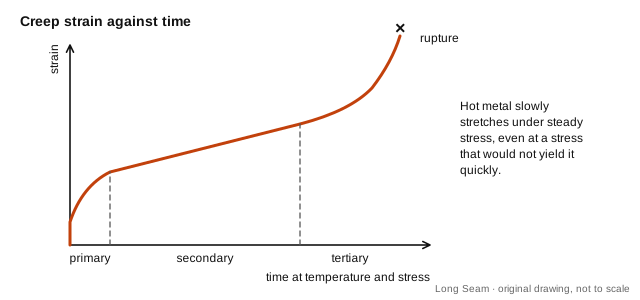
At room temperature, steel under a steady load below its yield strength simply carries the load. At high temperature, the atoms in the metal can move, and the same steady load makes the metal flow very slowly. The deformation is permanent and it accumulates with time.
A creep test follows the strain through three stages:
- Primary. The strain rate starts fast and slows as the metal hardens against the load.
- Secondary. The strain rate settles to a fairly steady, slow value. Much of the equipment's useful life is spent here.
- Tertiary. The rate accelerates as voids form and join, the cross-section shrinks, and the part moves toward rupture.
Higher temperature and higher stress both speed it up, and small increases in either can shorten life a lot. That is why a heater tube or a pipe that runs hotter than intended, even for a while, can lose a good deal of its creep life.
Try one question
Question 1 of the free 10-question check on API 510. No signup.
IV. Practical knowledge - general
Which hydrotest situation carries the highest brittle fracture risk?
Choose an answer to begin
Where it shows and how it is found
Creep is a concern for equipment that runs hot and loaded for years, such as fired heater tubes, hot piping, and pressure parts in high-temperature service. Signs include bulging or swelling, bowing, and eventually cracks at stressed locations such as welds.
- Dimensional checks. Measuring diameter growth on tubes and pipe, and looking for bulges, is a common approach.
- Metallography and replication. Looking at the metal's microstructure for creep voids is used when the question is how much life is left.
- Knowing the temperature history. Because small temperature changes matter, records of overheating events carry weight.
Ask Patch before you buy AI your Long Seam study buddy
See what's on the API 510 exam, take the free 10-question check, or find the plan that fits you.
The API 510 course
Available now · instant accessLearn every Body of Knowledge section, work the calculations step by step, then prove it on timed exams.
- 8modules of lessonsEvery task on the outline
- 2full-length timed exams170 questions in 390 minutes each
- 481practice questionsEach one explained
- 6worked calculationsStep by step
- 1week-by-week study planSet to your exam date
Turn a practice answer into a study step. In untimed practice, ask Patch AI about any question you answer, follow up, then see your weakest topics and what to drill next.
Instant access. Terms and refunds · Secure checkout by Stripe
Every answer comes with a full explanation.
Mix-ups to avoid
- Creep versus fatigue. Fatigue needs cycling loads and can happen at ambient temperature. Creep needs steady load and high temperature.
- Creep versus yielding. Yielding happens when the stress exceeds the yield strength at once. Creep happens slowly under a stress that would not cause immediate yielding at that temperature.
- Creep versus brittle fracture. Creep is a hot, slow, ductile-type process. Brittle fracture is a cold, sudden one.
On the API exam
Creep is not one of the 15 mechanism paragraphs on API's effectivity sheet for September 2026 to May 2027, and API 510 questions on RP 571 come from the listed portions only. It is still useful background for understanding hot-service damage and for the terms in Section 2, and it matters in other contexts such as API 570 work and field practice. Check the sheet for your own exam window, because the list has changed between cycles.
Practice it
Check which mechanisms are on your window's sheet in the API 571 damage mechanisms list for API 510. Compare it with High-temperature hydrogen attack and Mechanical fatigue, or browse every term in the damage mechanism glossary.
Know the mechanisms? Check the rest of the Body of Knowledge
Take the free 10-question check. It is spread across the Body of Knowledge, needs no signup and explains every answer, so you see which domains to open first. The Long Seam course then adds a lesson for each domain, timed practice exams and a study plan from your exam date.
Sources
Show the list
- API 510 Exam Publications Effectivity Sheet, September 2026, January 2027 and May 2027, American Petroleum Institute
- API 510 Body of Knowledge, September 2026, January 2027 and May 2027, American Petroleum Institute
- API 510 Pressure Vessel Inspector: exam information, American Petroleum Institute
- API RP 571, Damage Mechanisms Affecting Fixed Equipment in the Refining Industry, 3rd edition, March 2020. Read the matching paragraph in your own copy.
Facts checked 25 October 2026 against the sources listed above. If something has changed, tell us and we will correct it within 2 business days.
Your next step
Ready to see where you stand on API 510?
Free, untimed and scored by domain. No signup.
Start the free 10-question checkAPI 510 course. Lessons, timed practice exams and a plan around your exam date. Get API 510 course · $199 See the plans or read the free sample lesson.Terms and refunds