Wet H2S damage: what it means for the inspector
Wet H2S damage is a group of problems in carbon and low-alloy steel exposed to water containing hydrogen sulfide. The corrosion reaction puts hydrogen into the steel, and that hydrogen causes blisters, internal stepwise cracking and cracking at hard weld zones. These forms are known as blistering, HIC, SOHIC and SSC.
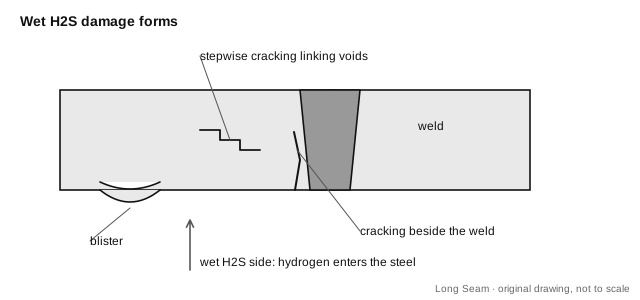
How it works
When steel corrodes in water that contains hydrogen sulfide, the corrosion reaction produces hydrogen atoms. H2S slows the step where those atoms would combine and leave as gas, so more of them enter the steel. Inside, the hydrogen collects at internal flaws and makes damage in one of four forms:
- Hydrogen blistering. Hydrogen collects at a lamination or inclusion near the surface, builds pressure and pushes the metal into a bulge.
- Hydrogen-induced cracking (HIC). Small cracks form at internal flaws and link in a stepped pattern through the thickness, with no applied stress needed.
- Stress-oriented hydrogen-induced cracking (SOHIC). Stepwise cracks line up in the thickness direction under stress, often near the edge of a weld.
- Sulfide stress cracking (SSC). Hard, high-strength steel, usually at hard weld zones, cracks under tensile stress in the presence of hydrogen.
The shared ingredients are water, H2S and carbon or low-alloy steel. The service has to be wet and sour. Steel cleanliness and weld hardness decide which form you are most likely to meet.
Try one question
Question 1 of the free 10-question check on API 510. No signup.
IV. Practical knowledge - general
Which hydrotest situation carries the highest brittle fracture risk?
Choose an answer to begin
Where it shows and how it is found
Sour water and sour gas equipment is the setting: separators, strippers, overhead systems, and similar vessels and piping.
- Blisters can be seen as bulges on the inner or outer surface, and straight-beam UT finds the void and the laminar flaws that feed it.
- Surface-breaking cracks at welds, including SSC, are found with wet fluorescent magnetic particle testing.
- Stepwise and internal cracks need UT methods that can see inside the wall, including angle-beam techniques.
Ask Patch before you buy AI your Long Seam study buddy
See what's on the API 510 exam, take the free 10-question check, or find the plan that fits you.
The API 510 course
Available now · instant accessLearn every Body of Knowledge section, work the calculations step by step, then prove it on timed exams.
- 8modules of lessonsEvery task on the outline
- 2full-length timed exams170 questions in 390 minutes each
- 481practice questionsEach one explained
- 6worked calculationsStep by step
- 1week-by-week study planSet to your exam date
Turn a practice answer into a study step. In untimed practice, ask Patch AI about any question you answer, follow up, then see your weakest topics and what to drill next.
Instant access. Terms and refunds · Secure checkout by Stripe
Every answer comes with a full explanation.
Mix-ups to avoid
- Wet H2S damage versus high-temperature hydrogen attack. Wet H2S damage happens in wet, low-temperature service. HTHA needs high temperature and hydrogen, and does not need water.
- Wet H2S cracking versus classical SCC. SSC needs stress. Blistering and HIC do not.
- Blistering versus a fabrication laminar flaw. A lamination found in plate is a manufacturing flaw. It becomes a blister when hydrogen collects there.
On the API exam
API's effectivity sheet for September 2026 to May 2027 limits RP 571 questions to Section 2 plus 15 mechanism paragraphs. Wet H2S damage (blistering, HIC, SOHIC, SSC) is RP 571 paragraph 3.67 and is one of the 15. Expect a stem with sour water or a wet H2S service, carbon steel and a damage pattern (a bulge, stepped cracking, or cracking near a hard weld), asking for the form or the method that finds it. Wording on the sheet changed from SCC to SSC between cycles, so make sure your notes use sulfide stress cracking.
Practice it
Practise telling the cracking forms apart on the API 510 damage mechanism quiz. Compare it with High-temperature hydrogen attack and Stress corrosion cracking, or browse every term in the damage mechanism glossary.
Know the mechanisms? Check the rest of the Body of Knowledge
Take the free 10-question check. It is spread across the Body of Knowledge, needs no signup and explains every answer, so you see which domains to open first. The Long Seam course then adds a lesson for each domain, timed practice exams and a study plan from your exam date.
Sources
Show the list
- API 510 Exam Publications Effectivity Sheet, September 2026, January 2027 and May 2027, American Petroleum Institute
- API 510 Body of Knowledge, September 2026, January 2027 and May 2027, American Petroleum Institute
- API 510 Pressure Vessel Inspector: exam information, American Petroleum Institute
- API RP 571, Damage Mechanisms Affecting Fixed Equipment in the Refining Industry, 3rd edition, March 2020, paragraph 3.67. Cited by number only; read it in your own copy.
Facts checked 25 October 2026 against the sources listed above. If something has changed, tell us and we will correct it within 2 business days.
Your next step
Ready to see where you stand on API 510?
Free, untimed and scored by domain. No signup.
Start the free 10-question checkAPI 510 course. Lessons, timed practice exams and a plan around your exam date. Get API 510 course · $199 See the plans or read the free sample lesson.Terms and refunds